
Showing posts with label books. Show all posts
Showing posts with label books. Show all posts
Thursday, October 18, 2012
Photo A Day October, Day 18: Made You Smile Today
Today's Photo A Day prompt was "made you smile today." It was a long day for me because I got up extra early to go to the dentist before work, and I developed a sore throat throughout the day. So I came home and curled up with The Perks of Being a Wallflower. It's one of my all-time favorites, and one of my therapy sessions inspired me to re-read it. For my throat, I made some tea that my parents brought from their trip out west, which I poured into this mug that my dear friend painted for me. I'm alone tonight, technically, but in spirit, I'm spending the evening with Mom, Dad, Ashley... and Charlie. :) What's not to smile about?


Sunday, October 14, 2012
Photo A Day October, Day 14: Makes You Laugh
I didn't get around to my Photo A Day until late this evening. The prompt was "makes you laugh." Most of the things that make me laugh are more verbal than visual, so this was a bit tricky. I ended up with another pile of books. These definitely made me laugh when I read them. :)


Thursday, October 4, 2012
Photo A Day October, Day 4: What You Read
Today's Photo A Day prompt was "what you read." I took two photos again today. First, the work edition:

I don't know if I have mentioned that in addition to counseling, my new job entails lots of psychological testing, which I really love. I've gotten very familiar with about 15 different test manuals, but these are the ones I consulted today during my scoring and report-writing.
Now, the home edition:
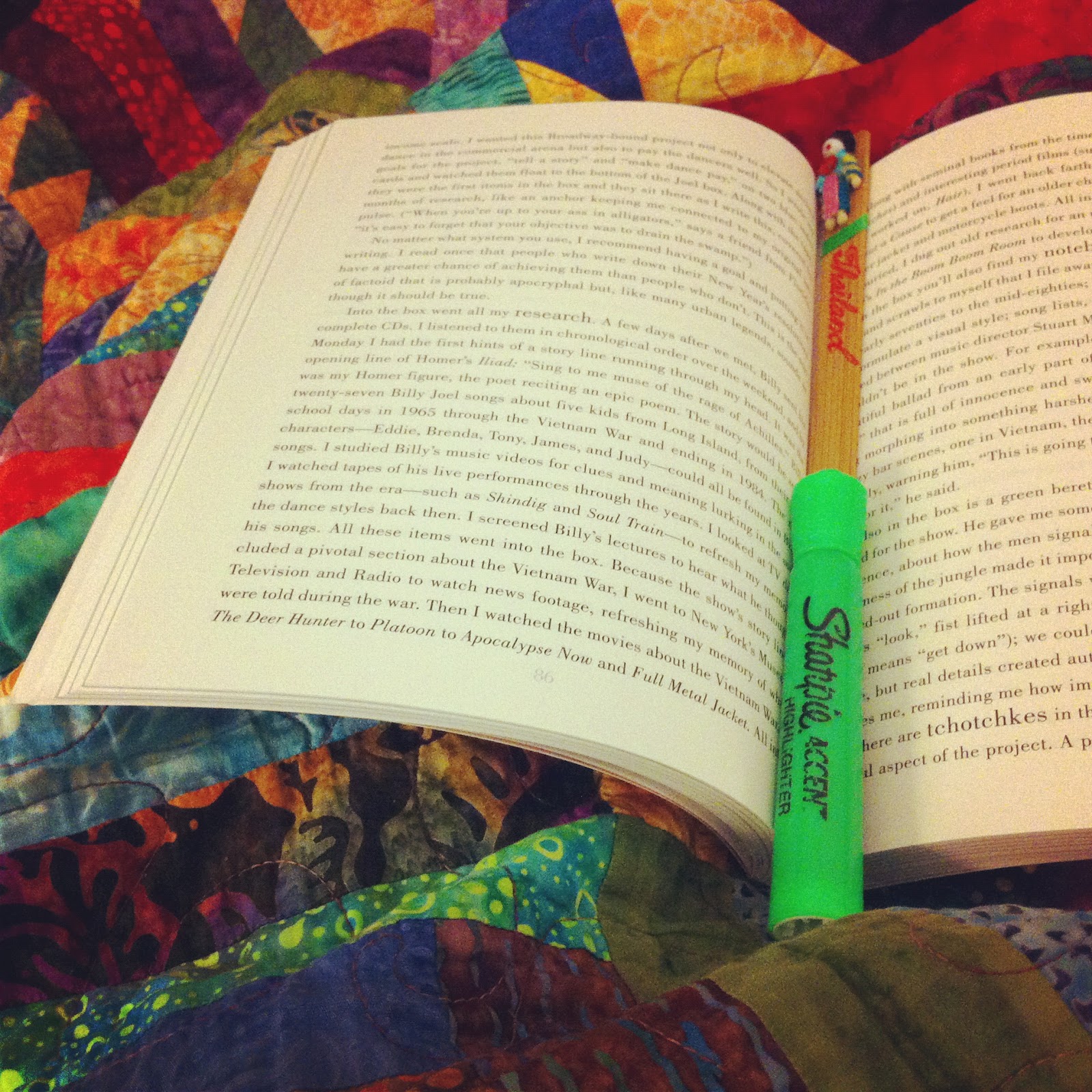
I must admit that this photo is staged, but soon I will be curling up in bed with this book (and yes, the highlighter--always.) It's The Creative Habit by renowned choreographer Twyla Tharp, and I'm really enjoying it. She has a lot of brilliant ideas to share. Maybe I'll blog about what I do with them when I finish the book. Come to think of it, though, I'm working on being more methodical about my creative "work" right now--that's the whole point of this Photo A Day project. Twyla would definitely approve. :)
Sunday, July 15, 2012
Paperback Rainbow
Remember the 21-day photo challenge I did back in May? Well, a couple of those photos finally made it to my Etsy shop! One of them is "Paperback Rainbow."

I really love this one. I hardly ever take pictures of books, but I love them more than I love just about any other tangible things. I picked these books for this shot because of their spine colors and similar sizes, but they turned out to be some of my favorites, too. This little photo is chock-full of literary goodness. In case you don't believe me, I've compiled a list of quotes from each one, from left to right--from Roy to G to Biv. :)
"Music is part of being human, and there is no human culture in which it is not highly developed and esteemed. Its very ubiquity may cause it to be trivialized in daily life: we switch on a radio, switch it off, hum a tune, tap our feet, find the words of an old song going through our minds, and think nothing of it. But to those who are lost in dementia, the situation is different. Music is no luxury to them, but a necessity, and can have a power beyond anything else to restore them to themselves, and to others, at least for a while." -Oliver Sacks, Musicophilia
"...handing everything over to Christ does not, of course, mean that you stop trying. To trust Him means, of course, trying to do all that He says. There would be no sense in saying you trust a person if you would not take his advice. Thus if you have really handed yourself over to Him, it must follow that you are trying to obey Him. But trying in a new way, a less worried way. Not doing these things in order to be saved, but because He has begun to save you already. Not hoping to get to Heaven as a reward for your actions, but inevitably wanting to act in a certain way because a first faint gleam of Heaven is already inside you." C. S. Lewis, Mere Christianity
"If they were not known to be contrary to the laws of nature how could they suggest the presence of the supernatural? How could they be surprising unless they were seen to be exceptions to the rules? And how can anything be seen to be an exception till the rules are known? ...Belief in miracles, far from depending on an ignorance of laws of nature, is only possible in so far as those laws are known." C. S. Lewis, Miracles
"When people say, 'You really, really must' do something, it means you don't really have to. No one ever says, 'You really, really must deliver the baby during labor.' When it's true, it doesn't need to be said." -Tina Fey, Bossypants
"...happiness has four stages. To eke out the most happiness from an experience, we must anticipate it, savor it as it unfolds, express happiness, and recall a happy memory." -Gretchen Rubin, The Happiness Project
"There are two spiritual dangers in not owning a farm. One is the danger of supposing that breakfast comes from the grocery, and the other that heat comes from the furnace." -Aldo Leopold, A Sand County Almanac
“If you never stepped on anybody's toes, you never been for a walk.” -Barbara Kingsolver, Prodigal Summer
"...I was going to be left alone on my butt on the other end of the continent. But why think about that when all the golden land's ahead of you and all kinds of unforeseen events wait lurking to surprise you and make you glad you're alive to see?" -Jack Kerouac, On The Road
"When God creates Eve, he calls her an ezer kenegdo....The word ezer is used only twenty other places in the entire Old Testament. And in every other instance the person being described is God himself, when you need him to come through for you desperately." -John and Stasi Eldredge, Captivating
"For so much of my life I had been defending Christianity because I thought to admit that we had done any wrong was to discredit the religious system as a whole, but it isn't a religious system, it is people following Christ; and the important thing to do, the right thing to do, was to apologize for getting in the way of Jesus." -Donald Miller, Blue Like Jazz
"...free will agrees very well with absolute necessity, for it was necessary that we should be free." -Voltaire, Candide
"There is but one good; that is God. Everything else is good when it looks to Him and bad when it turns from Him." -C. S. Lewis, The Great Divorce
"...only the person whom we really love, who touches our very roots, has the capacity to drive us crazy, and it may be only this person who has the capacity to help us find our deepest strengths." -Augustus Y. Napier and Carl Whitaker, The Family Crucible
Good stuff, eh? If I haven't convinced you that you need my print in your home library, I hope I've at least inspired you to get off the computer and go read a book. ;)
Monday, May 21, 2012
21 Day Photo Challenge, Day 15: Travel
The theme for Day 15 of the challenge was travel. I love exploring new places and cultures, so I was inspired by this one. I gathered up some travel paraphernalia from around the house and created some still life vignettes on the dining room table. I thought I was going to love a shot of Bermuda stuff including a beautiful article in the newest issue of Garden and Gun... but once I got it on my computer, I decided it was ugly. The only photo I liked was one of this map, but it was a little boring on its own, so I spiced it up with some text.

These words of wanderlust from On the Road really resonate with me. I always think it's weird when people say things like "I want to go to Italy" or "My dream is to go Hawaii." Why just those places? How can you just pick one? Anytime anyone says they want to go anywhere, I agree. Because I want to go everywhere.
Thursday, May 17, 2012
21 Day Photo Challenge, Day 11: Words
Today's challenge theme is words. I had always planned on taking a picture of a book page for this one, but I didn't know which one. I'm a big-time bibliophile, so the possibilities were a little overwhelming. I already used the Bible for Day 9, so I figured it should be something else, but what? Harry Potter? C. S. Lewis? Emily Dickinson? So many wonderful choices. I assumed this would be an after-work decision.
But then, I had a no-show at work. Sometimes--and especially on Thursdays when I work at a small satellite office away from all my stuff--this means I have nothing to do. So I always have a book in my purse for these occasions. I had just finished one (The Know-It-All by A. J. Jacobs), so it was time to start something new: The Schopenhauer Cure by Irvin D. Yalom. He is a brilliant psychiatrist and psychotherapist and probably my favorite living writer. He writes about psychotherapy in a way that reminds me why I love it and gives me hope that helps me keep coming to work everyday despite paperwork and bureaucracy and budget cuts and an overwhelmingly large caseload. His books have helped me believe (on good days, anyway) that in spite of all that junk, I can be effective by engaging with people in an authentic way and acknowledging all those existential issues that are hard to talk about. Like the fact that we are all going to die:

Yep, that's the first page. Good stuff, huh? I'm excited for the rest of this journey with Irv. (That's what his clients call him, and I kind of feel like I'm one of 'em.)
I guess the sentiment here isn't so different from Day 9. The grass withers, and bubbles burst, but life is beautiful in spite of that. Or, perhaps, because of it.
Thursday, May 10, 2012
21 Day Photo Challenge, Day 4: Rainbow

I didn't have much spare time today, so I squeezed in this book shot in a hurry between work and a lovely evening out. My book collection is color-coded already, so it was pretty easy to organize quickly. I like it a lot, though! Colors and books make my world go 'round. :)
Saturday, October 1, 2011
I'm in a book!
I had a very exciting surprise waiting at my doorstep a couple of days ago. It was this book:

As soon as I unwrapped it, I remembered being contacted via my flickr stream last year about publishing a photo in an upcoming book of images of reflections. I submitted a few more but had long since forgotten. It turns out that these THREE photos made it:


See for yourself!


Needless to say, I'm a little bit excited. :)
Monday, March 1, 2010
being > doing
In the field of counseling, we spend a lot of time researching, writing, and talking about different treatment approaches. Some disciples of certain theoretical orientations or interventions seem to be quite invested in making sure theirs are the “best.” But data (and experience) keep telling us that what we “do” as therapists matters less than how we do it—or maybe even who we are. We use the term “common factors” to refer to things like genuineness, empathy, hope, warmth, and unconditional positive regard—things that characterize good therapists whose clients experience improvement. Sometimes we conceptualize this as “being,” contrasting it with the “doing” of interventions.
I’ve always believed in the idea that the most important thing is that I care about my clients, but sometimes, in session, it doesn’t feel like enough. I can care all day long, but what if I don’t know what to do? I’ve begun to trust my instincts a lot more than I did at first, but sometimes I still wonder if the “common factors” are really all they’re cracked up to be.
But Alexander and I had our third pre-marital counseling session with our pastor on Sunday, and it really restored my faith in the idea that being is more therapeutic than doing. You see, our pastor is 1) very young and 2) not a counselor at all. He makes no bones about the fact that he is not trained in counseling and is largely winging it. I have to admit that I sometimes find myself silently assessing what he’s doing and thinking about all the ways I would do it differently if I were in his shoes. For example, this week, Alex and I completed a questionnaire about the “five love languages” (based on this book), and our session focused on a discussion of our results. Except there was no “processing” of our experience completing the questionnaire or even of our initial responses to our results. We turned them in, he interpreted them, he talked about what they might mean for us. It was several minutes before either of us had an opportunity to say anything at all. Our pastor didn’t ask us if his words made sense to us; he didn’t ask us for examples (though I gave some anyway.) Knowing what I know about using psychological assessment in counseling, I would say that he did it all wrong. And speaking in this technical sense, I might even say that what he “did” was a waste (at least for me), because the information that the questionnaire gave us was not news to me—I already know how I communicate love. I already know how Alex communicates love. I already recognize that these aren’t always the same, and I already work hard both to communicate love in the way he receives it and to recognize when he’s communicating love to me. From an intervention/treatment/ “doing” perspective, it was useless.
And yet… it wasn’t! At all! It was a really, really, really positive experience that I enjoyed quite a lot. Our pastor is very intelligent, and a really nice guy. He’s real with us. He’s present with us. He welcomes us, he likes us, he deeply desires for us to be blessed and fulfilled in our marriage, and he faithfully believes that we will be. We left our session feeling happy, refreshed, confident, supported, loved, and excited about what’s ahead. And what more could I want for my clients than that?
Monday, February 2, 2009
25 things
1. I don't really love Mississippi, and I'm not particularly happy with my program, but I continue to be very glad that I made the crazy decision to move here. This realization kind of freaked me out for a while, but I'm beginning to feel more comfortable with it.
2. My obsession with grammar plays a more significant role in my life than most people think. I think that people think I'm just trying to be funny or show off that I know more than they do, but I REALLY do get very anxious about errors. If I can take a picture of it and put it in my photo album, it makes me feel better, but it's the errors in books--especially textbooks--that really get me. Sometimes, I have to put the book down and take some deep breaths before I can focus again.
3. One of the coolest things I did in college was reading the Old Testament with my friend, Pete. I still miss S.P.O.T. time sometimes.
4. I have very little confidence in my cooking ability, and I get really nervous when I'm cooking for other people (especially if they're watching me), but I'm actually not so bad at it.
5. I don't like it when people misspell my first name. Today, the woman working at Starbucks asked for my name to write on my cup, and she actually asked, "H or no H?" I was embarrassingly appreciative of this gesture.
6. I've become really bad at keeping in touch with my friends, and I feel terrible about it. There are several people I really want to reconnect with, but I feel uncomfortable about picking up the phone and saying, "Hey...I haven't talked to you in a year. How's life?"
7. On a related note, I miss Emory, Virginia terribly and constantly. I'm afraid that I won't ever be in a community that I love as much as that one.
8. My two favorite boys...I mean men...in the whole world are Alex M. and Alex M. In that order. ;)
9. I feel silly about it, and I haven't actually made any money, but having an etsy shop has been a very rewarding, affirming experience.
10. I know most people think it's "personal" or "touchy," but I actually enjoy talking to people about Graves' Disease. I try not to bring it up, because people seem to think I shouldn't want to talk about it, but when people express curiosity and ask questions, I am incredibly happy to educate them.
11. My favorite Christmas present this year was a United Methodist hymnal with my name engraved on it.
12 I REALLY love my last name. I used to plan never to change it, but for some reason, I've begun to rethink this lately, and it kind of stresses me out.
13. I love books, and I am very possessive of them. I will not borrow books from other people, because I need to do my own highlighting and writing, and I need to have each book on my (color-coded) shelf for future reference (and for decoration.) For the same reason, I hesitate to loan books to other people, which I know is really lame. I loaned a book to someone over a year ago, and I'm pretty sure he never read it. I'm afraid he may have lost it, but I'm afraid to ask.
14. I don't value the idea of having a Ph.D. as much as I used to, but there ARE things I'd like to do that pretty much require it. We'll see.
15. I'm not really sure why I quit blogging. I want to start again, but I get overwhelmed trying to figure out where to start. So much has happened.
16. I grew up in the best neighborhood in the whole world with the best possible people, and I am convinced that no one had a better childhood that we did. When I think of paradise, it looks a lot like Hunter Court, dusk, summer, circa 1992.
17. My Gryffindor tie is one of my favorite articles of clothing, and I'm sad that I'll have very few more (appropriate) opportunities to wear it.
18. Every time I play that "2 truths and a lie" game, I say, "I'm related to (a) Bill Clinton's college roommate, (b) Katie Couric's makeup artist, and the (c) guy who invented the sandwich."
19. Sometimes it makes me sad that I don't have one, single, "best friend," but really, I'm lucky, because I have about 5 of them.
20. Sometimes, when I really connect with an author's writings, I start to feel so intimately connected with the person that I refer to them as if we're on a first name basis. Examples include Emily (Dickinson) and Augusten (Burroughs.)
21. Speaking of writers, I credit C.S. Lewis with completely revolutionizing the way I understand God.
22. I will never, ever be able to adequately thank Dr. Qualls for everything he has done for me. His teaching, guidance, insight, and encouragement continue to impact my life in very real ways.
23. During my senior year of college, I made a vow that I would never be the president of anything ever again.
24. Lately, I've been thinking a lot about working with adolescents. During my time working at Pathways, I found that I connected with them particularly well, especially with group art therapy. Right now, I'm teaching gifted middle/high school students about psychology in a 7-week program, and it has reminded me how much I love this age group.
25. I really haven't learned that much about psychology since I've been here, but I've learned a lot about love.
Friday, June 27, 2008
modifier modification
I think I've mentioned that I've been doing a lot of editing for my boyfriend--both of his still-not-finished thesis and of a travel journal he wants to make into a book at some point. I find this work to be very satisfying because it gives me the power to fix grammar errors. However, since becoming an editor in this regard, I've noticed an increase in the intensity of the psychological discomfort I experience when I encounter grammar errors that I cannot fix, which is to say, most of them. I feel especially uneasy when these are errors which will be read by many people, who, I fear, won't even know the difference. My Grammar Errors album on facebook has served as a helpful antidote to this discomfort, but it only works for errors that are big enough to photograph, which excludes those found in books, Christmas newsletters, and online forums. In an effort to alleviate a bit of my current annoyance with misplaced and dangling modifiers, I am going to catalog just a few here.
I'll start with one I ran into 6 months ago but which has stuck with me. Dear friends of mine, in their first Christmas letter as a married couple, wrote the following sentence: "After exactly ten years as a vegetarian, Nathan's first Thanksgiving turkey has Katie eating meat." The modifier here is supposed to be modifying Katie, the (former, apparently) vegetarian, but, grammatically speaking, it is actually modifying the turkey, which is the subject of the sentence. Ergo, if one were to read this sentence the way it is written, one would properly assume that this turkey was a vegetarian (and also at least 10 years old, for that matter.) A correct sentence would have been something like this: "After exactly ten years as a vegetarian, Katie eats meat: namely, Nathan's first Thanksgiving turkey!"
Katie and Nathan should know better, because, well, everyone should know better, but it gets worse. As it turns out, plenty of people who make a living by writing make this same mistake! Take A.J. Jacobs, whose book, The Year of Living Biblically, I am currently reading (and loving, but that's beside the point.) A few pages ago, I read the following pair of sentences: "I spend a half hour tidying the medicine cabinet. I notice that the ingredients in Chlor-Trimeton go all the way from A(acacia) to Z(zein), which, as a former encyclopedia reader, appeals to me. " The former encyclopedia reader, of course, is A.J. himself. It is not zein, nor is it the fact that the ingredients go from A to Z (either could be concluded from the grammatical arrangement of the sentence as it is). The sentence, therefore, should go something more like this: "I notice that the ingredients in Chlor-Trimeton go all the way from A(Acacia) to Z(zein), which appeals to me, a former encyclopedia reader."
Even my beloved Augusten Burroughs has trouble with modifiers. In his most recent book, A Wolf at the Table (which was a little disappointing to me--and not just because of the grammar), he writes the following sentence: "Despite slathering himself with lotion, blood continued to soak through his clothing, making him look stabbed, wounded." This one is actually, in my opinion, worse than the ones I just mentioned, because the object of the modifier is not merely far away from the modifier, but is actually completely absent from the sentence. This modifier, therefore, is "dangling" rather than just "misplaced." The modifer ("despite slathering himself with lotion") is obviously referring to a person (hence the personal pronoun "himself"), but there is no person in the sentence at all. It's a mess. Here's a better version: "Even as my father slathered himself with lotion, his blood continued to soak through his clothing, making him look stabbed, wounded."
Perhaps the most heartbreaking dangling modifier I have seen latley was one I ran into on the etsy forums. When you read it you'll understand why it's heartbreaking. Here it is: "As a former English teacher, yes, that would be a correctly used set of commas in your example." That's right. An English teacher dangling a modifier. It makes me cry a little. Who is this person? Well, that's the thing; we don't know who she is, because she is not the subject of the sentence like she should be. What she meant, I hope, was this: "As a former English teacher, I can tell you that you have used commas correctly in your example." (To her credit, she was right about the commas.)
The moral of the story is this: When you write a sentence with a modifier in it, ask yourself what (or who) you are referring to, and then make sure that this person/place/thing/idea is 1) in the sentence and 2) next to the modifier. In doing so, you will not only communicate more clearly and accurately; you will also make a positive impact on my personal mental health.
Thank you, and have a nice day.
Friday, May 23, 2008
orange you glad...
For my third etsy-items feature, I'm using yet another color-themed treasury that should have been on the etsy front page. :) Bright orange is not typically a favorite of mine, but I love this grouping (and it matches the logo!)
 Arguably the most unusual item from the list is this clock made out of Tupperware(!) and aptly named, "Leftovers, Again." The creativity of etsians is limitless, it seems--who would have thought to make a clock out of tupperware?! Well, apparently, Eric of IMOTIME. And Tupperware is just the beginning! Eric's shop is full of clocks made of everyday items including but not limited to a lawnmower wheel, a circular saw blade, an exit sign, a frying pan, and a license plate. Fabulous. If you haven't checked out his shop yet, well (sorry, I can't resist), it's about time. :)

Like this clock, many of the most fascinating etsy finds are functional objects made out of other functional (but no longer used) objects. Re-purposed, I believe, is the proper word. I've come across several etsy sellers, for instance, who make journals out of old books, and I can't get enough. I love books and I love journals, so what could be better than a journal made out of a book? One example is this adorable Green Eggs and Ham journal made by Jacob of bookjournals (appropriate name, huh?) Check out his shop for many more--he uses a wide variety of books!
 No treasury would be complete without at least one photograph, and I adore this one by Kate (aka chicalookate.) It's humorous and playful, and yet there's a lot of room for thoughtful interpretation of the message. For example, when I first saw it, I thought the detour was to Easy Street, which made the photo seem like a vacation, as in quit whatever you're doing and come take it easy for a while. But then it occurred to me that it could be just the opposite: maybe the sign itself is on Easy Street, but there's a detour ahead. In this case, the photo may be serving as a warning, a wise old sage, speaking from experience when telling us that if everything seems to be going exactly right... things are about to change. Watch out. Who knew a simple road sign could be so full of philosophical possibilities? Not all of chicalookate's photos make my over-analytical head spin quite like this one, but they are all truly lovely. And there are lots of them, so head on over to her shop to explore the rest. :)

Here's a list of the the other fantastic sellers whose orange items appeared in this treasury: hrsmithjones, dazeychic, michellechristina, KimsCustomCaps, KrillaGlass, project8256, LeastLikely2Breed, accesori, annacote. Orange you glad you know about these amazing artists and crafters? ;)
Saturday, May 3, 2008
MS
When I heard the news, I changed my facebook status to "Sara is getting an M.S. in MS!" Much to my amusement, my friend Krista's immediate thought was that I was currently in McGlothlin-Street Hall (on Emory's campus) contracting Multiple Sclerosis. Not quite. In reality, I was announcing that I'll be getting a Master's degree in Mississippi. And now that I think about it, the real story might not be any less random and unexpected than Krista's fictionalized account. I never, ever thought I would be moving to Mississippi.
Of course, this didn't happen all at once. All winter, I worked on applications to Ph.D. programs. My hopes were high, but I never really felt like it was going to work out. In the back of my mind was the idea that later, I would have to apply to Master's programs as a back-up, but my ego kept persuading me to put it off. Then I got this phone call from my boyfriend who was in Mississippi interviewing for a job he originally didn't think he wanted but was now quite excited about. He was in the car and had just driven by a (not the, we now know) campus of the University of Southern Mississippi. He was frantic, beseeching me to investigate this school immediately and find out if they had a program for me to apply to. I obliged him, and found that they do have a clinical psychology Ph.D. program... but the deadline had passed. They also have a counseling psychology Ph.D. program... but the deadline had passed. The deadline that wasn't passed was for the Master's program in counseling psychology. No. No, no, no. That's not what I want. At first, I didn't even want to consider applying. But I did consider it. And I prayed, and I thought, and I analyzed, and I over-analyzed, and I listened.... and I applied.
Alexander decided he wanted the job, and he got it. My brain was reeling for a long time, trying to figure out what I wanted. I was afraid of being away from him, afraid of losing him, but it was so unlike me to make a major life decision based on a guy. I couldn't even believe I was thinking that way. I didn't want to admit that I was. But I was. And I was ok with that. And that freaked me out. I never said it out loud, but at some point I realized that I want to be with him more than I want a Ph.D. And certainly more than I want a Ph.D. right now. But still, could I possibly turn down an offer to start a Ph.D. program? Even if I did, nobody would approve, and could I really blame them? So I prayed that that wouldn't happen--that there would be no decision to make. I prayed that if God wanted me in Mississippi, He wouldn't let me get in to a Ph.D. program. And much to the understandable chagrin of my parents, I decided not to apply to any other Master's programs. I prayed for discernment, and while I didn't get any audible answers from God, I kept feeling more and more at peace with my desire to go to Mississippi. I went. I interviewed. I loved it. I felt like I was clearly the best candidate. It was a done deal.
Except that I didn't get in. I got an email telling me I was an alternate. I was devastated. And so, so confused. I decided that it had to be because of my withdrawal from school, and I started getting very angry (again) about Graves' disease. Hadn't it already screwed up my life enough? Was I never going to be able to get past it? I didn't get along very well with God for a few days, but I tried to think that things would work out. I got a lot of love and support and prayer, and Dr. Qualls made a phone call for me which I think might have changed everything. Eventually, obviously, I got in. And I'm going! I'm going to live with Missy, a fellow Christian, fellow nerd, fellow grammarian who I bonded with at our interview day. I'll be about 80 miles from Alex, who will be in Ocean Springs, right on the gulf coast. I could not possibly be more excited. It's perfect. Completely perfect. And completely crazy.
I never thought I would get a degree in counseling psychology. I never thought I would move to Mississippi. But here's the thing: I never thought I would get sick and have a part of my body radioactively destroyed; I never thought I would leave school; I never thought I would live with my parents post-college; I never thought I would work at Pathways again; I never thought I would be a youth leader; I never thought I would sell art; I never thought I would fall in love with my friend's brother-in-law.
But here I am.
Paradoxically, it's actually quite comforting to be doing something so unlike what I ever predicted. It is because it's so crazy that I know it's God. It's nothing close to what I ever planned for myself, so it must be His plan. How else could I have ended up here? One of my favorite scriptures for a long time has been Matthew 10:39, in which Jesus says, "Whoever finds his life will lose it, and whoever loses his life for my sake will find it." I've had lots of discussions about what exactly this means, and I think there are a lot of interpretations, all of which are probably valid. I used to think of it as a dichotomy: two sets of people. Finders of life, losers of life. Finders get lost, losers get found. But what I've found, it seems, is that I'm both. Or rather, I was one, and then I became the other. I did try to "find" my life. Though I certainly tried, I really can't say that I was ever able to completely surrender my life to Christ. I said I did, and sometimes I even thought I did, but really, in the back of my head, there were certain expectations I had--things I expected God to include in His plan because I wanted them. I wouldn't (couldn't?) totally "lose" my life, my plan. But then... well, I did lose it. This is where my understanding of the scripture has changed. I always thought this "losing" had to be a willful, purposeful surrender. For some people, of course, it is. Those people are stronger than me. My "loss" of life was something that happened to me, not something I chose. But who's to say that that means it wasn't lost "for Christ's sake," as in the scripture? I'm an imperfect, flawed, tremendously proud person, not righteous enough to hand over my whole life. But God, in his infinite, miraculous grace, took it from me anyway. Because he loves me so very much, he redirected my life, helped me find my life again--my real life, the one I'm meant for.
What a beautiful thing.
But what a long journey it has been to this point where I finally feel like I know at least a little bit of what God is doing. In My Utmost for His Highest, Oswald Chambers wrote these words:
"God does not tell you what He is doing. He reveals to you Who He is."
I have found that to be so true. Through this whole process, I have felt so clueless as to what would happen, and yet God has shown me so much of his nature. One of the most poignant examples happened while I was in Mississippi for my interview. Late at night after the day of my interview, I was sitting outside our motel room, where I had been talking to Alexander on the phone. Even though I was optimistic about my qualifications, I was feeling very anxious about getting in to USM. We had had a wonderful conversation that only strengthened my desire to be in Mississippi--my desire to be with him. I'm going to sound like one of my borderline clients when I say this, but I was feeling downright desperate. So I started praying right there on the sidewalk. It went something like this: "God, please please please let me get in. I just want to be with him so badly. So badly, God. Do you understand me? That's what I want. Nothing else seems important. It's like I don't care about anything else except being with him. Even if I hated this place and hated this program and hated everyone here, I wouldn't care because I'd get to be with him. I just want to be with him so badly..." I was being illogical and emotional and yes, slightly ridiculous, but it was how I felt, and I kept going and going because I didn't think God understood. I didn't think he knew what this passionate, desperate feeling was like because, you know, he had never been in love. But then a funny thing happened: God laughed at me. Now, he wasn't laughing at my feelings, of course. He was laughing at the idea that I had to keep going on and on explaining things to Him as if he didn't know. I didn't realize this at first, though, and I just paused, confused about the distinctive sense I had that God was chuckling. Once I let my mind get quiet, I'm pretty sure what He said to me was, "Now you know how I feel."
It wasn't any sort of intellectual, theological idea, but it was as if I suddenly understood God's love in a whole new way. God didn't send Christ to die for us because of some sort of corporate love. It wasn't because it was "the right thing to do." It wasn't because God is "good" and he wants "what's best for us." These things are true, of course, but what God seemed to be telling me was that His love is romantic--erotic. Christ died because he wanted to be with us so badly. He was desperate. He was passionate. He was in love.
I am so thankful that he lets us participate in that love, to share it with each other in our measly little human way. After all, 1 John 4:19 tells us that "We love because He first loved us." All the love in my life--and yours--originated with Christ and is rooted in Him. The Lord has never ceased to amaze me. And if I've learned anything, it's that He never will.
Thursday, February 7, 2008
changing everything
"Let him be fifty feet away, let him not even speak to you, let him not even see you, he permeated, he prevailed, he imposed himself. He changed everything."
-Virginia Woolf, To the Lighthouse
Twice I've thought I had everything planned out, lined up, orchestrated. Twice everything turned upside-down, rearranged itself, was rudely interrupted. Last time, by Graves' disease, this time, by love, with all its blessed and beautiful inconvenience.
-Virginia Woolf, To the Lighthouse
Twice I've thought I had everything planned out, lined up, orchestrated. Twice everything turned upside-down, rearranged itself, was rudely interrupted. Last time, by Graves' disease, this time, by love, with all its blessed and beautiful inconvenience.
Wednesday, October 24, 2007
Henry's higher latitudes
That one measley Walden Pond picture just wasn't enough. How about a little more Thoreau goodness?
 "I would rather sit in the open air, for no dust gathers on the grass..."
 "Be rather the Mungo Park, the Lewis and Clarke and Frobisher, of your own streams and oceans; explore your own higher latitudes...Nay, be a Columbus to whole new continents and worlds within you, opening new channels, not of trade, but of thought."

"...beware of all enterprises that require new clothes, and not rather a new wearer of clothes."

"Books are the treasured wealth of the world and the fit inheritance of generations and nations."

And my favorite:
"Only that day dawns to which we are awake."
Am I awake? Are you?
Tuesday, October 23, 2007
a new thing (or 5)
"See, I am doing a new thing!
Now it springs up, do you not perceive it?"
(Isaiah 43:19)
I perceive it, all right.
Where do I start? Why haven't I written in so long?
Big deep breath. Here goes.
Homecoming weekend at Emory was fantastic. I finally contacted my favorite professor/friend/hero, Dr. Qualls, which I had been needing to do for ages. I hadn't told him anything about what has been going on in my life. It turns out that he already knew about my Graves' disease and medical withdrawal from school, but he nonetheless deserved to hear it from me. I'm not sure why it took me so long to tell him; I think I was afraid of disappointing him. Which was ridiculous, and I knew it. But still the mere thought of him--of all people--not being proud of me was so scary that I just hadn't been able to face the risk. But it had really been weighing on my heart, so at long last, I emailed him and arranged a time to meet with him. It was good for my soul to see and talk to him. He has taught me more than anyone else--about life, about people, about myself. I don't know who I would be if I didn't know him. It was a blessed reunion. He gave me a lot of helpful advice about the grad school application process, but also shared a lot of encouraging words about God's providence... and about the gifts I have and the clinician I'm going to become. Or am becoming. It was very uplifting, but also sad, because of our relflection on my senior year at Emory. I knew that he knew I was hurting then, but I didn't know until now how much it was hurting him. I should have listened when he told me I needed help. We both know that, but still, he didn't scold me. He didn't say he told me so. He just smiled through his almost-tears and said "Welcome back." I feel like he restored peace into my soul, sewed up the faint but still present wound of my feelings of failure and doubt, reintroduced me to myself.
Another joyous homecoming reunion: Dallas and Emory, together again at last. Having my best friend in my favorite place--and the place where we became friends--was tremendously exciting. It felt like the culmination of our semi-parallel healing processes. We took our typical Sara/Dallas middle-of-the-night walk aroud campus, ending at our typical spot by the duck pond for our typical discussion about the intricacies of life. So much has happened since the last time we did that. We are different. Our friendship is different. Everything is different. And yet, everything is exactly, mysteriously, wonderfully, the same.
All in all, it was a weekend of coming full circle.
The next weekend was also an exciting one. Joe and I headed to Boston to visit Jenny and Katie&Nathan. It was SO good to see them. Good friends are such a blessing, and the further away I am from mine, the more I appreciate them. We had a wonderfully fun visit. And I'm quite fond of Boston, I think. The highlight, however, was our trip to Walden Pond. I am a huge fan of Thoreau (and a general literature nerd), and it really was magical to be in the very place where Walden was inspiried and written. I don't see how anyone could behold its beauty and not be transformed into a transcendentalist.

Having experienced the real thing, I want to read Thoreau's masterpiece again. Except I think my obsessive reading habit is going to have to come to a tragic end, as my day-to-day life is about to get really busy. For a few reasons.
First, my job is finally about to start. I've had my first day of computer training, and I have three more this week, after which I will start working for real. I'm still fairly unclear about exactly what goes on at the crisis unit, but it sounds as if I'll actually be doing something that requires specific diagnostic and therapeutic skills that (I think) I have. Which is exciting.
Second, I'm exponentially increasing my church involvement. Ever since I started feelinig healthy again, I've been feeling a desire/need to serve in some capacity, but I really didn't know where to begin. I prayed that an opporunity would present itself, and sure enough, one did. Jo, a lovely woman who I dearly love, asked me to take over her role as senior high Sunday School teacher, which she has filled for something like 12 years. I regarded this request as a direct answer to my prayers and enthusiastically accepted. My plan is that we'll be reading and discussing parables indefinitely. This past Sunday was my first time teaching, and I think it went well. We talked generally about what and where parables are and then examined the parables of the mustard seed and the yeast (Matthew 13:31-35, Mark 4:30-34, Luke 13:18-21.) I figured it was a good one to start with since it's the only one that appears in all 3 of the gospels that contain parables. The kids seem to like me despite my demonstrating my nerdiness by coining the words "micro-kingdom" and "macro-kingdom" in my attempt to offer my interpretation of that oft-compared but never-defined "kingdom of heaven." I'm very excited about what's to come.
The thing is, I thought God was finished answering that prayer about service opportunities. I thought Sunday School was it. I checked "find a way to serve" off the list. But it seems that Sunday School was only the beginning. Another (bigger?) opportunity came along after church on Sunday, in the form of a message from my pastor, Gene, asking me to call him. I did. With what could only be understood as desperation in his voice, he asked me if I had any interest in leading the youth group. (Our youth director has just been fired, which I won't go into, because I don't really know anything anyway.) I told him that I'm getting ready to start a full-time job and the grad school application process and teaching a Sunday School class, and that I would be happy to help someone, but that I don't have time to be in charge. Trying to be polite, but clearly frustrated at my lack of understanding of the gravity of the situation, he explained that it's nice that I'll help, but he has no idea who I'd be helping. In other words, I'm the only hope. I'm really not sure how that happened, but I, too, am having trouble coming up with people who I think would want to take this (volunteer) job on. But, why me? Gene came over this afternoon to talk to me about it, and basically, the conclusion was.... I'm going to do it. Because I love youth. Because I love this church. Because I know how upset they are about their leaders leaving. Because I know how much some of them need a mentor and a listener. Because I don't want the youth program to die after we've worked at rebuilding it. I'm still very unsure about how I'm going to go about this, and I hope I can find someone to help me. I don't know how I fell into this position, but all signs seem to be pointing to me doing this. Except that I don't know if I'll have time. Or energy. But still, the idea is exciting. I'm still trying to sort it all out. I'm not sure if the take-home point is (a) I can do all things through Christ who strengthens me (Philippians 4:13) or (b) Be careful what you pray for. Maybe a little of both.
So, that pretty much sums up what's been going on with me. Except that somehow, accidentally, in the midst of all this, I fell in love.
Now it springs up, do you not perceive it?"
(Isaiah 43:19)
I perceive it, all right.
Where do I start? Why haven't I written in so long?
Big deep breath. Here goes.
Homecoming weekend at Emory was fantastic. I finally contacted my favorite professor/friend/hero, Dr. Qualls, which I had been needing to do for ages. I hadn't told him anything about what has been going on in my life. It turns out that he already knew about my Graves' disease and medical withdrawal from school, but he nonetheless deserved to hear it from me. I'm not sure why it took me so long to tell him; I think I was afraid of disappointing him. Which was ridiculous, and I knew it. But still the mere thought of him--of all people--not being proud of me was so scary that I just hadn't been able to face the risk. But it had really been weighing on my heart, so at long last, I emailed him and arranged a time to meet with him. It was good for my soul to see and talk to him. He has taught me more than anyone else--about life, about people, about myself. I don't know who I would be if I didn't know him. It was a blessed reunion. He gave me a lot of helpful advice about the grad school application process, but also shared a lot of encouraging words about God's providence... and about the gifts I have and the clinician I'm going to become. Or am becoming. It was very uplifting, but also sad, because of our relflection on my senior year at Emory. I knew that he knew I was hurting then, but I didn't know until now how much it was hurting him. I should have listened when he told me I needed help. We both know that, but still, he didn't scold me. He didn't say he told me so. He just smiled through his almost-tears and said "Welcome back." I feel like he restored peace into my soul, sewed up the faint but still present wound of my feelings of failure and doubt, reintroduced me to myself.
Another joyous homecoming reunion: Dallas and Emory, together again at last. Having my best friend in my favorite place--and the place where we became friends--was tremendously exciting. It felt like the culmination of our semi-parallel healing processes. We took our typical Sara/Dallas middle-of-the-night walk aroud campus, ending at our typical spot by the duck pond for our typical discussion about the intricacies of life. So much has happened since the last time we did that. We are different. Our friendship is different. Everything is different. And yet, everything is exactly, mysteriously, wonderfully, the same.
All in all, it was a weekend of coming full circle.
The next weekend was also an exciting one. Joe and I headed to Boston to visit Jenny and Katie&Nathan. It was SO good to see them. Good friends are such a blessing, and the further away I am from mine, the more I appreciate them. We had a wonderfully fun visit. And I'm quite fond of Boston, I think. The highlight, however, was our trip to Walden Pond. I am a huge fan of Thoreau (and a general literature nerd), and it really was magical to be in the very place where Walden was inspiried and written. I don't see how anyone could behold its beauty and not be transformed into a transcendentalist.


Having experienced the real thing, I want to read Thoreau's masterpiece again. Except I think my obsessive reading habit is going to have to come to a tragic end, as my day-to-day life is about to get really busy. For a few reasons.
First, my job is finally about to start. I've had my first day of computer training, and I have three more this week, after which I will start working for real. I'm still fairly unclear about exactly what goes on at the crisis unit, but it sounds as if I'll actually be doing something that requires specific diagnostic and therapeutic skills that (I think) I have. Which is exciting.
Second, I'm exponentially increasing my church involvement. Ever since I started feelinig healthy again, I've been feeling a desire/need to serve in some capacity, but I really didn't know where to begin. I prayed that an opporunity would present itself, and sure enough, one did. Jo, a lovely woman who I dearly love, asked me to take over her role as senior high Sunday School teacher, which she has filled for something like 12 years. I regarded this request as a direct answer to my prayers and enthusiastically accepted. My plan is that we'll be reading and discussing parables indefinitely. This past Sunday was my first time teaching, and I think it went well. We talked generally about what and where parables are and then examined the parables of the mustard seed and the yeast (Matthew 13:31-35, Mark 4:30-34, Luke 13:18-21.) I figured it was a good one to start with since it's the only one that appears in all 3 of the gospels that contain parables. The kids seem to like me despite my demonstrating my nerdiness by coining the words "micro-kingdom" and "macro-kingdom" in my attempt to offer my interpretation of that oft-compared but never-defined "kingdom of heaven." I'm very excited about what's to come.
The thing is, I thought God was finished answering that prayer about service opportunities. I thought Sunday School was it. I checked "find a way to serve" off the list. But it seems that Sunday School was only the beginning. Another (bigger?) opportunity came along after church on Sunday, in the form of a message from my pastor, Gene, asking me to call him. I did. With what could only be understood as desperation in his voice, he asked me if I had any interest in leading the youth group. (Our youth director has just been fired, which I won't go into, because I don't really know anything anyway.) I told him that I'm getting ready to start a full-time job and the grad school application process and teaching a Sunday School class, and that I would be happy to help someone, but that I don't have time to be in charge. Trying to be polite, but clearly frustrated at my lack of understanding of the gravity of the situation, he explained that it's nice that I'll help, but he has no idea who I'd be helping. In other words, I'm the only hope. I'm really not sure how that happened, but I, too, am having trouble coming up with people who I think would want to take this (volunteer) job on. But, why me? Gene came over this afternoon to talk to me about it, and basically, the conclusion was.... I'm going to do it. Because I love youth. Because I love this church. Because I know how upset they are about their leaders leaving. Because I know how much some of them need a mentor and a listener. Because I don't want the youth program to die after we've worked at rebuilding it. I'm still very unsure about how I'm going to go about this, and I hope I can find someone to help me. I don't know how I fell into this position, but all signs seem to be pointing to me doing this. Except that I don't know if I'll have time. Or energy. But still, the idea is exciting. I'm still trying to sort it all out. I'm not sure if the take-home point is (a) I can do all things through Christ who strengthens me (Philippians 4:13) or (b) Be careful what you pray for. Maybe a little of both.
So, that pretty much sums up what's been going on with me. Except that somehow, accidentally, in the midst of all this, I fell in love.
Friday, September 28, 2007
God, the Tao, and me
I just finished reading the Tao Te Ching in its entirety for the first time. I'm still not sure I understand the concept of the Tao (and perhaps its essence lies in its elusiveness?), but I think the poetry is beautifully revelatory. Chapter eleven especially resonated with me:
Thirty spokes share the wheel's hub;
It is the center hole that makes it useful.
Shape clay into a vessel;
It is the space within that makes it useful.
Cut doors and windows for a room;
It is the holes which make it useful.
Therefore profit comes from what is there;
Usefulness comes from what is not there.
How very true, even for my Western, Christian self. God uses me not in spite of, but because of my insufficiencies--my open spaces, my holes. For it is only when I acknowledge the extent of my inability, my "what is not there," that I can truly and fully invoke the power of the Holy Spirit, who can do all things. If I rely on "what is there"--on what I can do by myself--I may profit, but I will not be useful. The climax of my Graves' disease story was the moment of surrender--the "I can't." It was the beginning of the long healing process that brought me to this point, where I am able, again, to be a servant...an offering... used.
"...power is made perfect in weakness.... For when I am weak, then I am strong." (2 Corinthians 12:9-10)
Thank you, Lord, for making me inadequate.
Sunday, September 16, 2007
one autumnal face
No spring nor summer beauty hath such grace
as I have seen in one autumnal face
(John Donne)
Autumnal is such a good word. And it's true--fall is in the air. I love it. In celebration, a few of my favortite fall photos:


as I have seen in one autumnal face
(John Donne)
Autumnal is such a good word. And it's true--fall is in the air. I love it. In celebration, a few of my favortite fall photos:


Tuesday, September 4, 2007
Call me Ishmael.
A few weeks ago, I started writing an entry about the (many) books I've read since I last posted anything book-related. I never finished it, and the list of books is only getting longer, so I decided to go ahead and post a few thoughts about book #1, Daniel Quinn's Ishmael (no, not Moby Dick.)
It was great. I had heard a lot about the book from various people who read it for school, so I expected a lot, but still wasn't disappointed. Being excessively introspective as I am, I too often get so wrapped up in all the things happening within me that I fail to think about the grand scheme of things--the big picture. This book served as a powerful antidote to my selfishness. One thing I'd never given much thought to:
"At present there are five and a half billion of you here, and, though millions of you are starving, you're producing enough food to feed six billion. And because you're producing enough food to feed six billion, it's a biological certainty that in three of four years there will be six billion of you. By that time, however, (even though millions of you will still be starving), you'll be producing enough food for six and a half billion--which means that in another three of four years there will be six and a half billion...In order to halt this process, you must face the fact that increasing food production doesn't feed your hungry, it only fuels your population explosion."
This flaw in logic reminded me of a thought I had when I visited the US Bureau of Engraving and Printing in DC when I was in sixth grade. I was quite fascinated with watching the way money is printed. Realizing that money is something that people literally make with paper and ink, I thought, why, then, don't they just make more of it so that everyone will have enough? I eyed a man who was standing (behind the glass) at the end of a conveyor belt and tried to telepathically send him a command to print off some extra dollar bills and go hand them to all the homeless people outside. I think I had a vague sense, even then, that this act wouldn't actually eliminate poverty, but I lacked the economic vocabulary (and probably still do, much to the chagrin of my economics-major friend, Bethany) to determine just why not. It seemed so simple. But, of course, it wasn't. And yet, we're using the same logic in our attempt to elimiate world hunger. Though very troubling, I found this parallel rather enlightening.
I was also very interested in the book's discussion of the creation of the world in Genesis, partly because it was consistent with my personal (seemingly unpopular) view that Adam and Eve do not dichotomously represent man and woman in the neat and orderly way that seems to be widely accepted. I have always thought it important that the Hebrew words for Adam and Eve do not mean "man" and "woman, but, rather, "human" and "life," respectively, and Quinn, using these definitions, brings to light an eerily sensible etiology not only of the human race, but of modern Western culture. It's brilliant. I could say much more about this book, but I'll stop before I start quoting entire chapters. Let me just say that if you haven't read it, you should: I promise you'll enjoy yourself and learn a little (or big) something.
Thursday, July 26, 2007
listening ears
Last weekend was fantastic. I love that I've sort of been adopted into my brother's group of friends. We went out on John's boat for a full day of tubing, cliff-jumping, rope-swinging, and the like. It was good fun. And, of course, Harry Potter was truly magnificent. I have a lot to say about it, but I'll wait a few days before risking spoiling anything for anyone. At this point, I will just say that it was beautiful and wonderful and I loved it. But I'm incredibly sad that it's all over now. After I finished the book, I just sort of walked around my room like, oh... what do i do NOW? It's very hard to believe that this massive and intricate story is complete; that the adventurous journey I've been on for 6 years is over. Forever. I'm being dramatic, but it feels like I already miss the characters, as if they're my friends. As if they're even real. But in the words of the infinitely wise Albus Dumbledore, "Of course it is happening inside your head, Harry, but why one earth should that mean that it is not real?"
Things are also quite good in the non-literary part of my life (which is, joyfully, the minority.) The past few days have brought several opportunities for me to engage in my favorite activity: listening. Listening is what I love. It's what I do. I've always been a person to whom people come to talk about their problems, and that's something that I have always taken pride in and immensely enjoyed. However, while I was sick, I had a lot of trouble listening well; I was in so much pain myself that it was tremendously difficult for me to step outside of my own issues and empathize with those of others. I was somewhat aware of this at the time, but I didn't fully realize how much I missed that part of my life until it re-emerged the other day on a walk around the park with Tyler. It's when I listen to people--really listen to the real stuff of their inner lives--that I feel most alive, most purposeful. It's then that I feel most clearly that God is using me in just the way He planned to use me. And I have begun to feel that on a near-daily basis again, as two other friends have since come to me needing to talk. I feel resurrected. I am so glad that these opportunities have presented themselves to me and that, more importantly, I've been able to rise to the occasions. I'm still not 100% better physically, but I'm emotionally healthy enough now that I have been able to listen the way I used to, which is a huge blessing, as much (maybe more) for me than for those who've come to me with problems. I'm back. And my name isn't Frasier Crane, but...I'm listening. :)
Things are also quite good in the non-literary part of my life (which is, joyfully, the minority.) The past few days have brought several opportunities for me to engage in my favorite activity: listening. Listening is what I love. It's what I do. I've always been a person to whom people come to talk about their problems, and that's something that I have always taken pride in and immensely enjoyed. However, while I was sick, I had a lot of trouble listening well; I was in so much pain myself that it was tremendously difficult for me to step outside of my own issues and empathize with those of others. I was somewhat aware of this at the time, but I didn't fully realize how much I missed that part of my life until it re-emerged the other day on a walk around the park with Tyler. It's when I listen to people--really listen to the real stuff of their inner lives--that I feel most alive, most purposeful. It's then that I feel most clearly that God is using me in just the way He planned to use me. And I have begun to feel that on a near-daily basis again, as two other friends have since come to me needing to talk. I feel resurrected. I am so glad that these opportunities have presented themselves to me and that, more importantly, I've been able to rise to the occasions. I'm still not 100% better physically, but I'm emotionally healthy enough now that I have been able to listen the way I used to, which is a huge blessing, as much (maybe more) for me than for those who've come to me with problems. I'm back. And my name isn't Frasier Crane, but...I'm listening. :)
Subscribe to:
Posts (Atom)